Ask ChatGPT to recommend a good accountant in your city, and you’ll get a short list of names with a sentence or two about each. If your business isn’t on that list, the person asking may not find out you exist. That used to be a niche worry. The numbers below suggest it’s quickly becoming an ordinary one.
I wanted to know what actually decides which businesses show up in those answers, so I went through the research that exists so far. It’s younger than the research on Google. Also, outside researchers can’t see exactly how ChatGPT picks its answers. Still, a handful of solid studies and OpenAI’s own documentation point to steps a small business can take without buying anything.
More people are asking AI before they hire
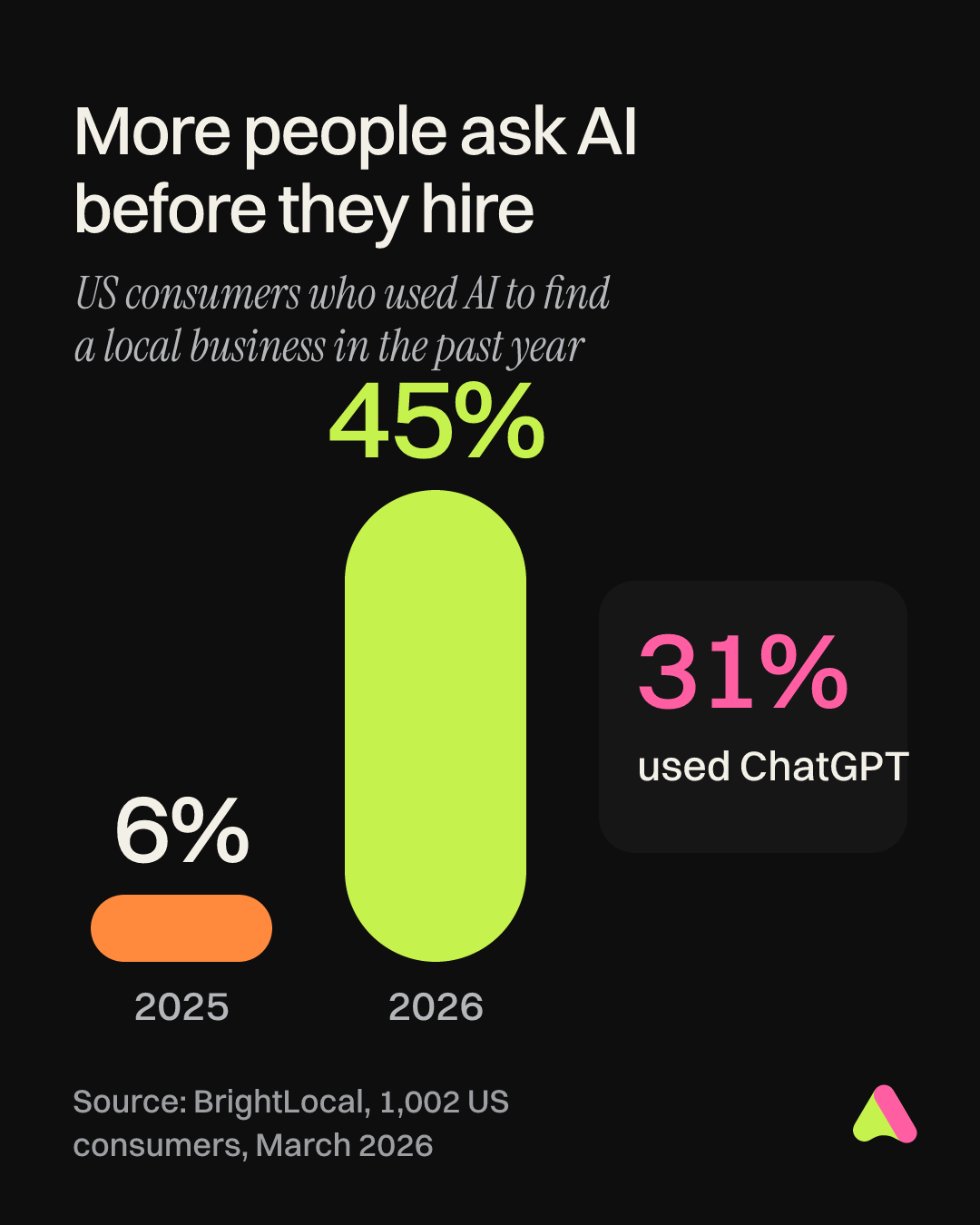
In March 2026, BrightLocal published a survey of 1,002 US consumers on how they use AI to choose local businesses. The share who had used AI to find a local business recommendation was 45%, up from 6% in the company’s previous survey. Part of that jump may come from how the question was asked, so I’d treat the exact growth with some caution. The direction is hard to miss, though, and ChatGPT led the tools, with 31% of consumers using it for a business recommendation in the past year.
Adults aged 30 to 44 were the most active group, with 64% of them having asked an AI tool for a recommendation. That’s a lot of people in their prime hiring and buying years.
ChatGPT’s reach is wider than local searches, too. A Pew Research Center survey of 5,123 US adults found that 34% had used ChatGPT by early 2025, roughly double the share in 2023. Among adults under 30, it was 58%.
Step one: let ChatGPT see your website
This sounds too basic to mention, which is exactly why it gets missed. ChatGPT finds websites for its search answers using a crawler called OAI-SearchBot, and OpenAI’s documentation on its crawlers is blunt about what happens if you block it: “Sites that are opted out of OAI-SearchBot will not be shown in ChatGPT search answers.”
Some websites block it without the owner knowing. The cause might be a security plugin, a hosting firewall or a robots.txt file copied from an old template. So the first job is to ask whoever manages your site to check two things: that your robots.txt file allows OAI-SearchBot, and that your firewall isn’t turning away OpenAI’s requests. OpenAI notes that changes to robots.txt can take about 24 hours to register.
There’s a second OpenAI crawler worth knowing about, called GPTBot, which collects content for training future AI models. The two are separate settings. You can block training and still allow search, so you don’t have to choose between privacy and being found.
Get mentioned in places other than your own site
The strongest research on AI visibility so far looks at Google’s AI Overviews rather than ChatGPT, but it’s the closest thing we have, and its finding surprised me. In a study of 75,000 brands, Ahrefs measured which factors lined up most closely with a brand being mentioned in AI answers. The winner by a clear margin was how often the brand was mentioned across the web. Backlinks, the thing most SEO advice obsesses over, had one of the weakest connections.
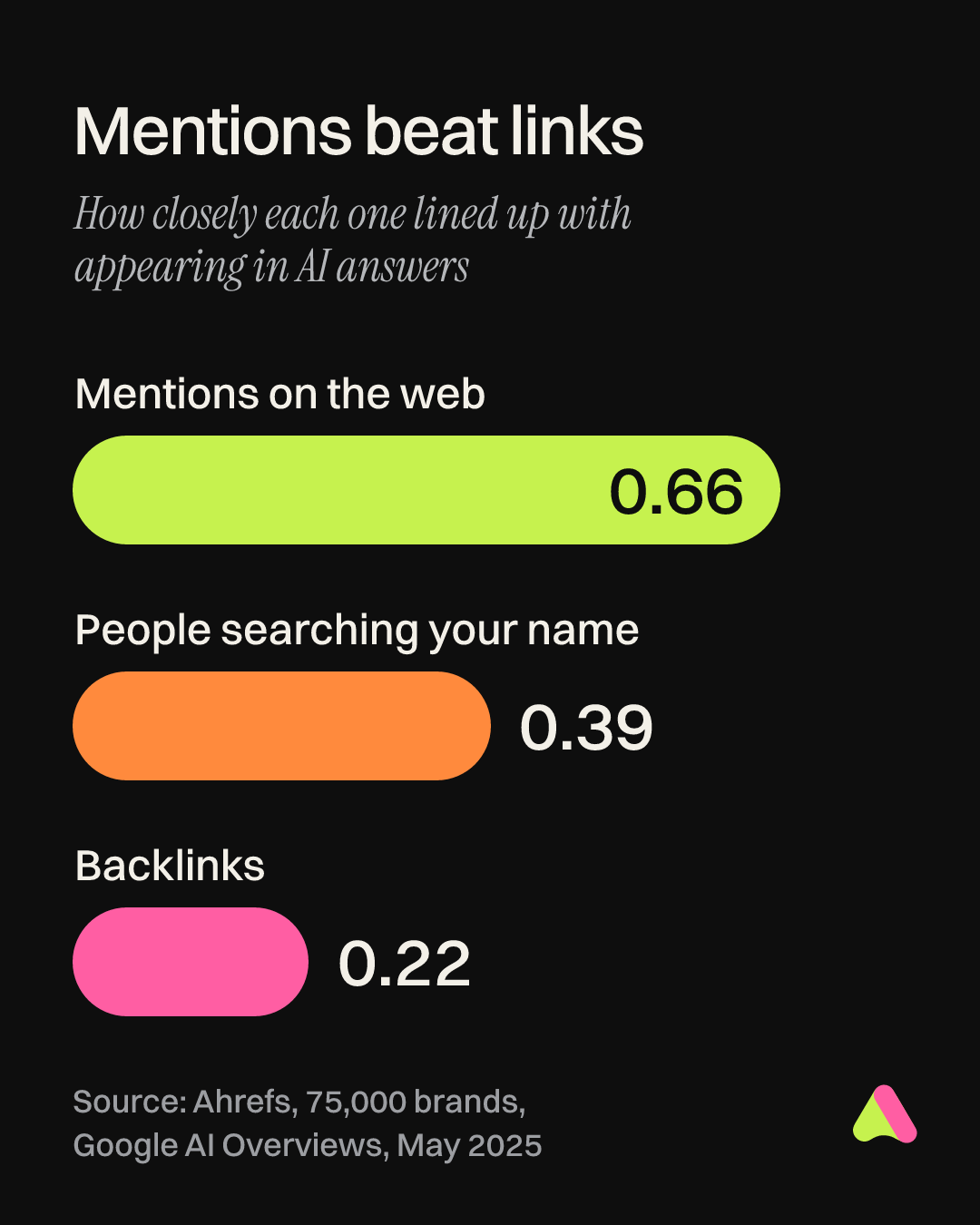
Ahrefs is careful to say these are correlations. More mentions don’t prove that the mentions caused the visibility. It also makes intuitive sense, though. An AI answer is built from what the web says about a topic, and a business that only describes itself on its own website gives the AI very little to go on.
For a small business, mentions come from ordinary places: a local news story, a supplier’s case study, an interview on an industry podcast, a listing in a respected trade directory, a guest article for a professional association. None of these need to link to you to count as a mention. They need to name you, clearly and accurately, next to the thing you do.
Write pages that are easy to quote
One of the few academic studies on this comes from researchers at Princeton University and other institutions. Their paper on generative engine optimization was accepted at KDD 2024, a major data science conference. The team tested different ways of rewriting web content and measured how much of it AI-generated answers went on to use.
Three changes stood out: citing sources, adding quotations and adding statistics. Together, these produced a relative improvement of 30 to 40% on the paper’s main visibility measure. Keyword stuffing, the old trick of repeating a phrase as often as possible, offered “little to no improvement.” It’s oddly satisfying to see that one fail in a lab.
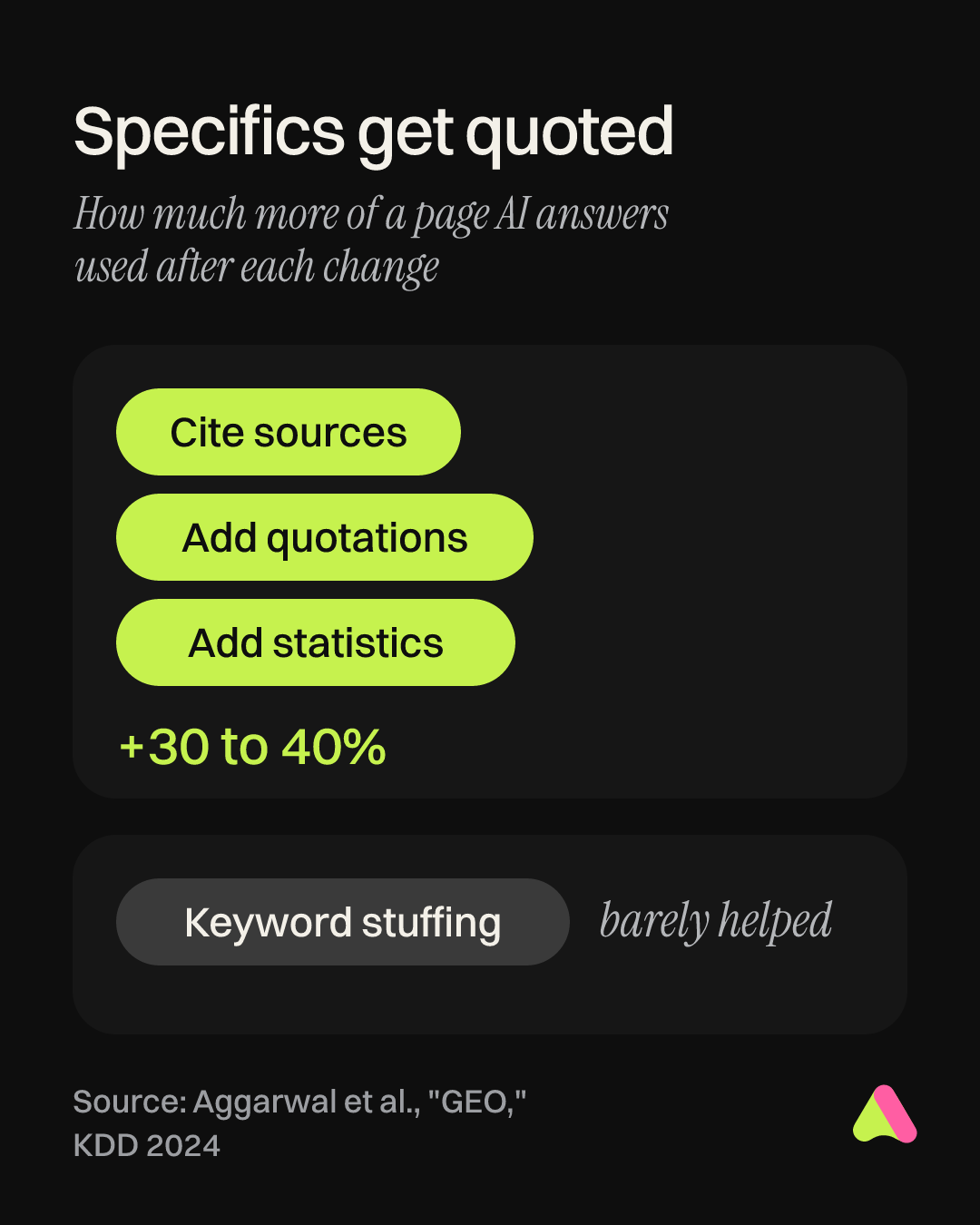
Translated into a small business website, that means writing the kind of page a careful journalist could pull a fact from. Give real numbers, like how many projects you completed last year or your typical turnaround time. Quote real customers by name, with their permission. When you mention an industry rule or a statistic, link to where it came from. The authors also found that what works varies by subject, so treat this as a direction, not a formula.
Make your business easy to double-check
People don’t take AI recommendations on faith. In the same BrightLocal survey, 88% of the people who used AI tools said they fact-check the reviews an AI points them to. A business that looks thin under that second look can lose the customer the AI sent its way.
That makes the unglamorous basics matter more. Your business name, address, phone number and opening hours should match everywhere. That means your website, your Google Business Profile and any directories you’re listed in. Reviews spread across a couple of trusted sites look more convincing than a pile on one. And your website should answer the questions people ask before they get in touch, which we covered in our piece on the five jobs of a service page.
How to check where you stand
The simplest test is to ask. Open ChatGPT and type the questions your customers would type, including your town or region, such as “Who’s a good wedding photographer in Leeds?” or “Which bookkeepers in Austin work with restaurants?” Try a few versions, because answers change from one conversation to the next. Note who appears, what’s said about them, and which sources ChatGPT links to.
Then look at your website analytics. In Google Analytics, check your traffic sources for visits from chatgpt.com. The numbers may be small for now, but they’re the clearest sign that the steps above are working. If you’ve noticed your Google traffic changing at the same time, our article on why Google is sending fewer clicks covers that side of the picture.
What this adds up to
There’s no setting you can switch on to guarantee a place in ChatGPT’s answers, and I’d be wary of anyone who sells one. What the research does show is encouraging for small businesses that do good work: the signals that seem to help are the ones that come from being genuinely known. Let the crawler in, get your name mentioned in trustworthy places, write pages full of specifics, and keep your details consistent. Those steps also make you easier to find and easier to trust for customers who don’t use ChatGPT at all.
If you’d like a hand with any of it, from the website to the writing, we’d be happy to help.