If you’ve opened Google Search Console lately and felt your stomach drop a little, you’re not imagining things. If your impressions are holding steady while your clicks slide, the reason is often sitting right at the top of the results page: a neat AI-written answer that hands people what they wanted before they ever reach your site.
I spent the past few weeks reading the most reliable research I could find on this, from independent researchers, SEO data companies and Google itself. The studies don’t agree on every number, which is normal when each team measures things its own way. They do agree on the direction, and they point to a fairly clear set of things a small website can do about it.
How much less clicking are we talking about?
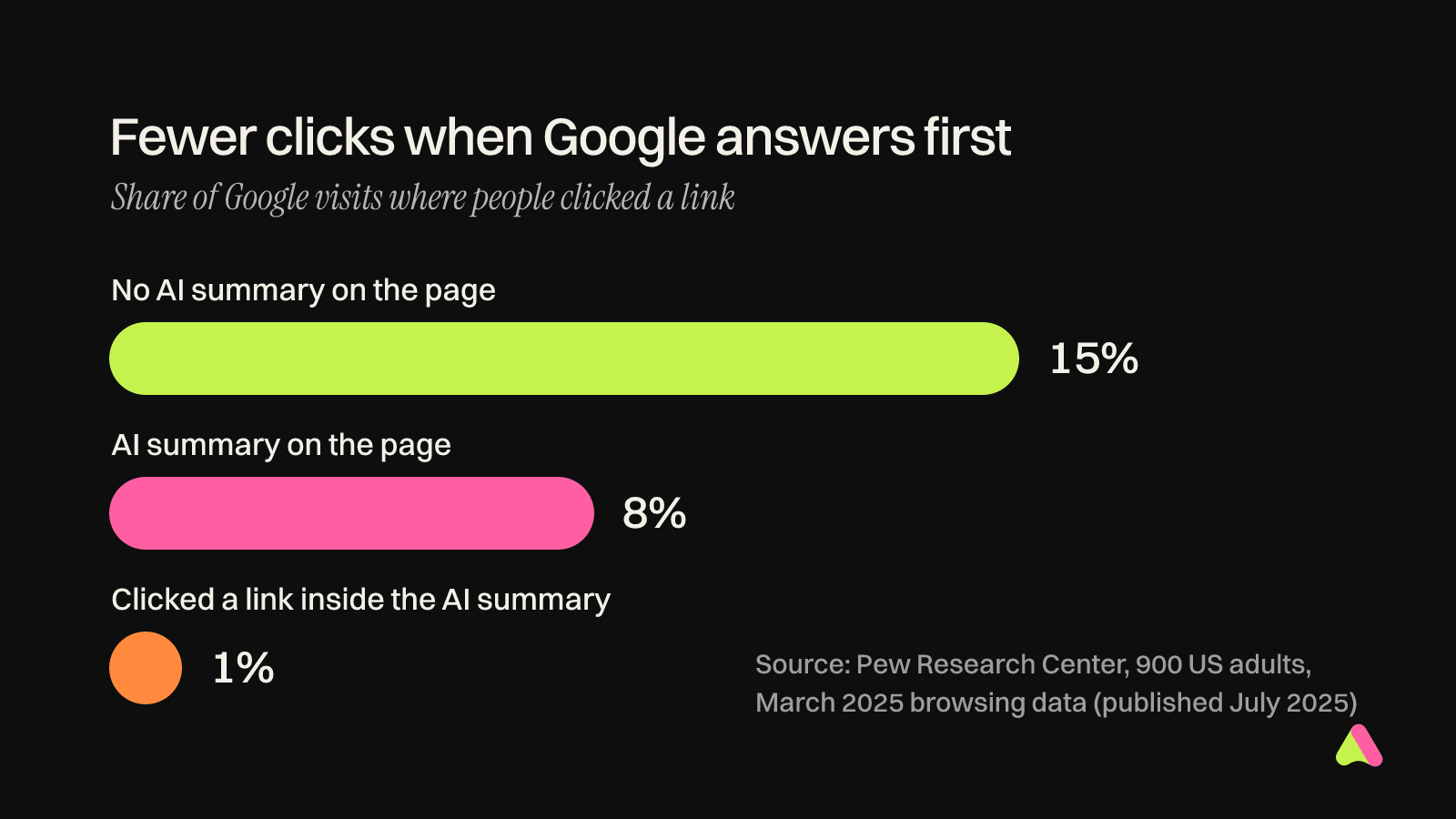
The cleanest look at real behavior comes from the Pew Research Center. Its researchers tracked the browsing of 900 US adults through March 2025 and published what they saw in a study on how people respond when Google shows an AI summary. When a summary appeared, people clicked a regular search result on 8% of visits. When it didn’t, they clicked on 15%. The links tucked inside the summary itself got clicked on just 1% of visits.
Pew noticed something else that I keep thinking about. After seeing an AI summary, people ended their browsing session entirely on 26% of those pages, compared with 16% of pages showing only the usual list of links. For a lot of searchers, the summary was the destination.
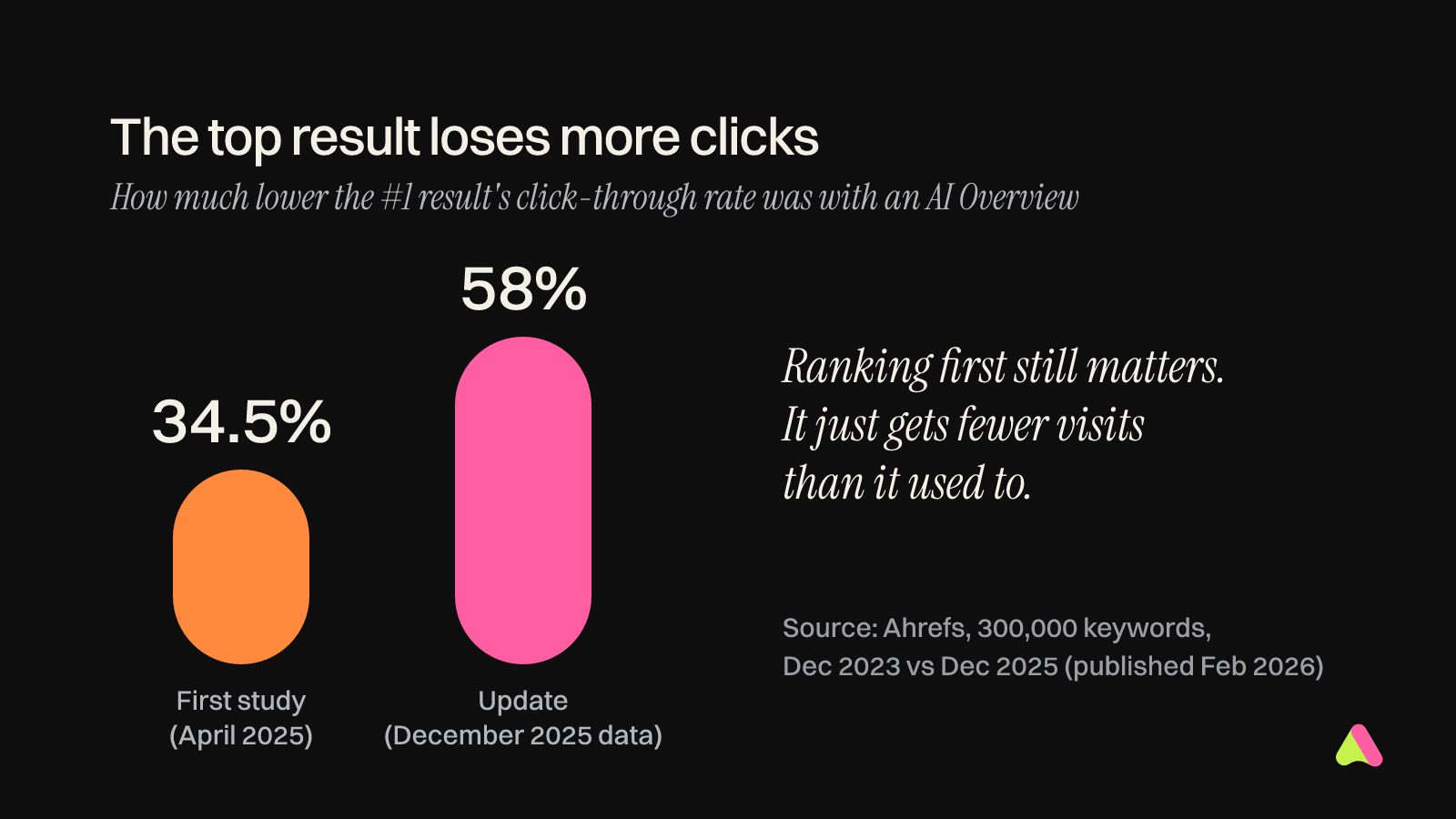
SEO tool companies, which see search data at a much larger scale, report the same pattern from the website’s side. In February 2026, Ahrefs published an updated study of 300,000 keywords comparing December 2023 with December 2025. When an AI Overview was present, the top-ranking page had a 58% lower average click-through rate. Their first version of the study, less than a year earlier, had put that figure at 34.5%. Ranking first still matters, but first place in 2026 is a quieter spot than it used to be.
Google says the clicks are better, and that can also be true
Google’s own view is more cheerful, and it deserves a fair hearing. In August 2025, the head of Google Search, Liz Reid, wrote that total organic click volume has been “relatively stable year-over-year” and that Google is sending “slightly more quality clicks” than it did the year before. She defines a quality click as one where the visitor doesn’t quickly bounce back to the results.
I couldn’t find the underlying numbers in that post, so I can’t check them the way I checked the studies above. Still, the claim isn’t silly. If an AI summary answers the easy part of a question, the people who keep going are often the ones with a real need, and those are the visitors a business wants anyway. Google’s Search Relations team makes the same point in its advice for doing well in AI search, where John Mueller writes that visitors arriving from results pages with AI Overviews “are more likely to spend more time on the site.”
Put the two sides together and a sensible picture appears. Fewer people click, especially on simple questions, and the ones who do click tend to arrive further along in their thinking. That’s a different job for your website than the one it was built for, which brings us to where the losses land.
Which searches are losing the most
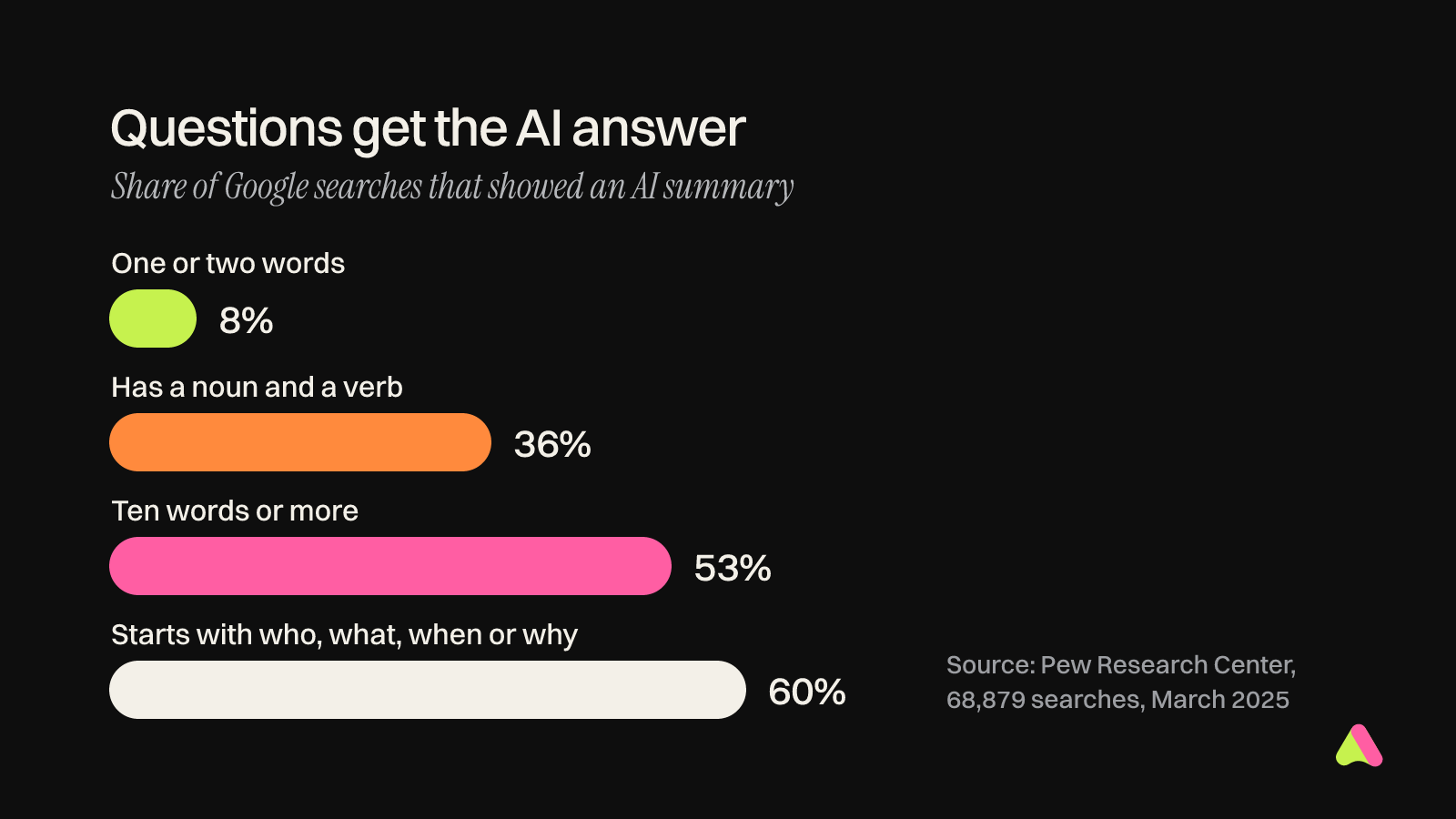
AI summaries don’t show up on every search, and this is where the research gets useful for planning. In Pew’s data, 18% of all Google searches produced an AI summary, but the share changed a lot with the kind of search. Only 8% of one or two word searches got a summary. For searches of ten words or more, it was 53%, and for searches starting with a question word like “who,” “what,” “when” or “why,” it was 60%.
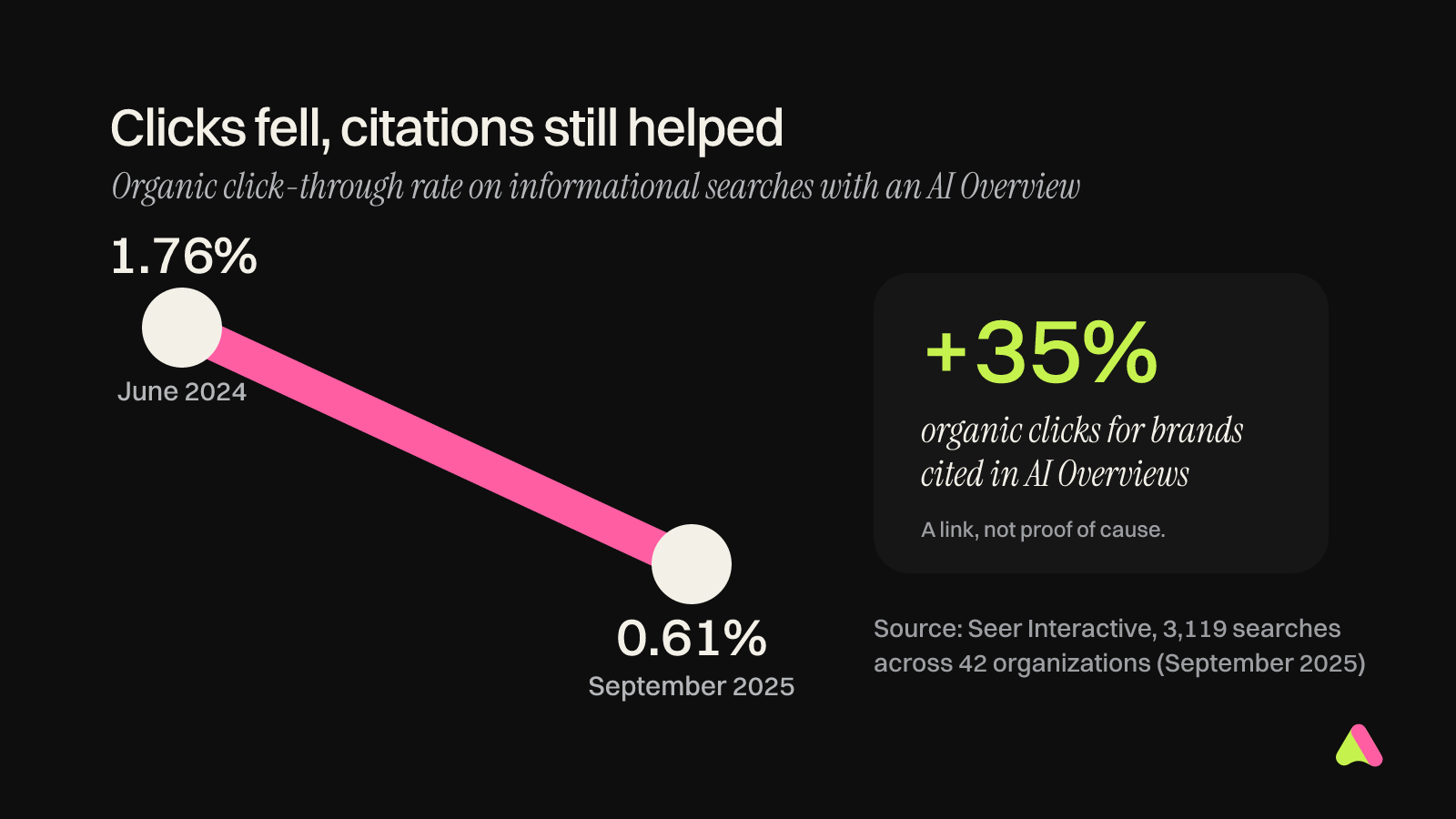
Research from Seer Interactive backs this up from a different angle. Looking at 3,119 informational searches across 42 client organizations, Seer found that the organic click-through rate on searches with an AI Overview fell from 1.76% in June 2024 to 0.61% by September 2025. Searches without an AI Overview dropped too, though less sharply, and Seer is careful to say its results may look different for commercial or local searches.
For a small business, that’s a helpful split. The articles that answer a general question, like “what is a mortgage broker” or “how often should I service my boiler,” are the ones an AI summary can replace most easily. The searches that come from someone ready to hire, like “boiler service near me” or a company’s own name, are shorter and more specific, and they have more of their value intact. If most of your search traffic comes from explainer posts, you’re likely to feel this change sooner.
What I’d do with a small business website right now
None of what follows needs a new tool or an expensive “AI SEO” package. Google’s guide to AI features and your website is unusually direct about this: “There are no additional requirements to appear in AI Overviews or AI Mode, nor other special optimizations necessary.” The fundamentals still do the work. What changes is where you put your effort.
Make each visit worth more
If fewer people arrive, the pages they land on have to do a better job. That means a clear explanation of what you offer, real proof, a rough idea of cost and an easy next step. We wrote a whole piece on the five jobs of a service page, and this is the moment to put it to use. A page that turns 4% of its visitors into enquiries instead of 2% can lose half its traffic and still bring in the same number of leads.
Publish what a summary can’t copy
Mueller’s advice is to focus on “unique, non-commodity content.” In plain words, write the things only you can write. That might be your actual prices, photos from real jobs, the mistake you see customers make every week and how you’d fix it, or your honest opinion on which option is worth the money. A summary can retell general facts, but it can’t invent your experience, and that’s the material people click through to find.
There’s a second reason to do this. Seer found that brands cited inside an AI Overview earned 35% more organic clicks than brands that weren’t, although the researchers are clear that they can’t prove the citation itself caused the difference. Being the source with something specific to say looks like a good way to end up on that list.
Show up where the summaries look
Pew also tracked which sites the AI summaries leaned on. The three most cited were Wikipedia, YouTube and Reddit. Most small businesses won’t be writing Wikipedia entries, but a short YouTube video answering a common customer question is well within reach, and it gives Google another place to find you. Google’s own guide also tells site owners to keep their Business Profile information up to date, which is a small job with a big audience, since local customers see it right in the results.
Measure the right thing
Traffic from AI Overviews and AI Mode is counted in Search Console’s Performance report under the “Web” search type, according to the same Google guide. So the data you need is already there. Watch impressions and clicks side by side. If impressions hold while clicks fall, people are still seeing you, and the summary is answering their first question. Then look at what actually pays the bills: calls, form fills, bookings. Mueller suggests the same thing, warning that site owners “might not optimize” for the visitors they do get “if you focus too much on clicks instead of the overall value of your visits.”
The visitors who still click
The research paints a clear picture without needing any panic. Fewer people click through from Google, especially on general questions, and the drop has grown over the past year. The people who still click through are often looking for something specific, and Google says they stay longer once they arrive.
That second group is who your website should be built for now. They’ve already read the summary. They want the details, the proof and the person behind the business. Give them a page that’s worth the click, and you’ll feel the change in your leads far less than you feel it in your traffic chart. If you’d like help getting your site there, we’d be glad to take a look.